One operational workspace
Exercises and live incidents share the same workflows, roles, world model, and evidence-driven decision process.

SafeSite Response
Incident Intelligence
SafeSite Response is a Crisis Intelligence Platform designed to help teams manage rapidly evolving situations with greater clarity, coordination, and human control - during both live incidents and training exercises.
By combining governed AI, human-led decision workflows, and an Operational World Model built from organisational knowledge, operational analogs, and site context, SafeSite helps responders reduce cognitive overload, recognise escalation patterns, and maintain a clear, defensible operational picture under pressure.
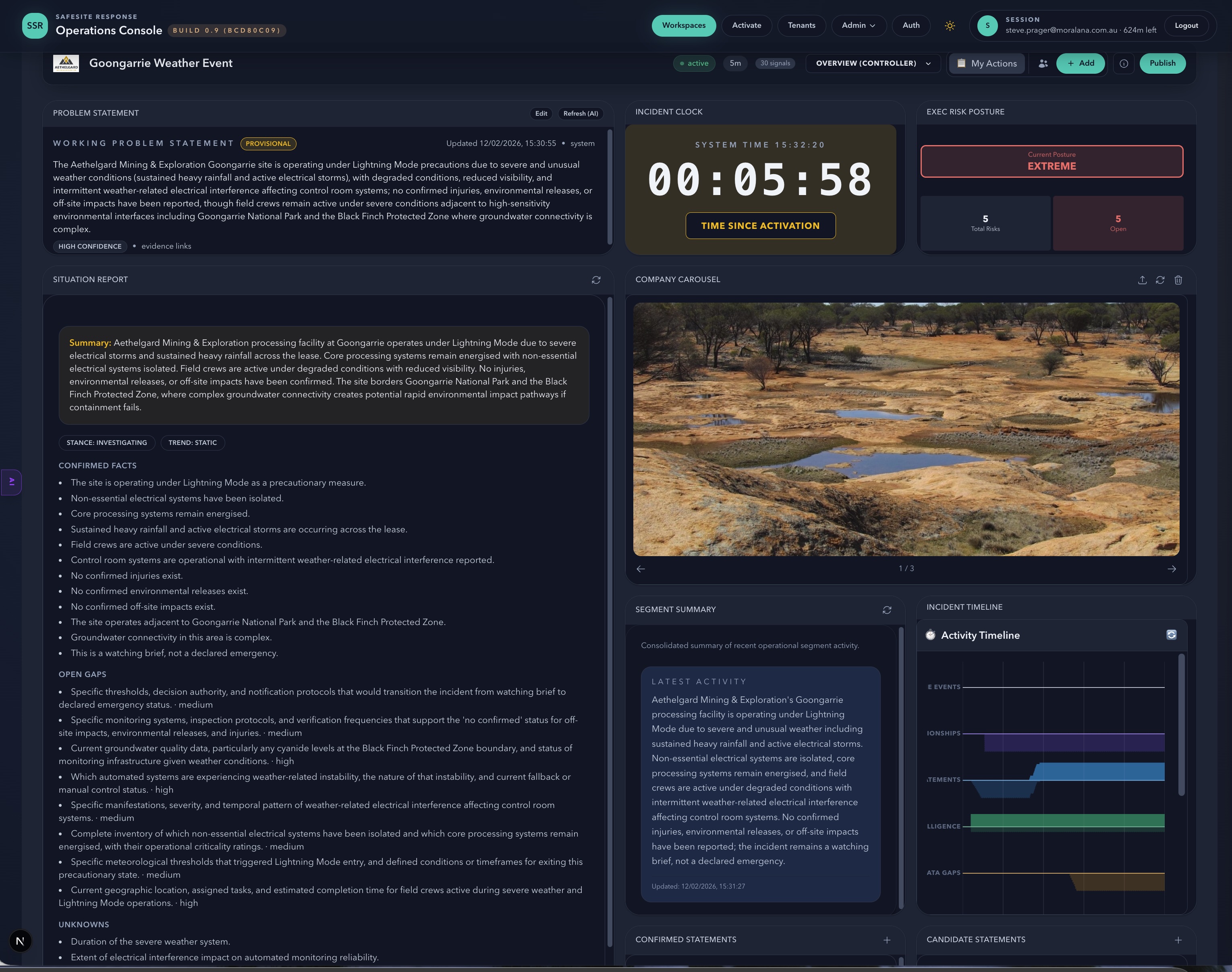
Live command picture
A calmer operating surface for facts, risks, decisions, and actions.
Live response and training
SafeSite Response uses a single operational environment for every stage of the response lifecycle. Teams don't switch between training tools and incident tools - they work the same way every time.
One operational workspace
Exercises and live incidents share the same workflows, roles, world model, and evidence-driven decision process.
Complete operational history
Every observation, decision, action, and piece of evidence is preserved for review, governance, and audit.
Continuous operational learning
Exercises become better exercises. Incidents improve future responses. Every event contributes to a richer Operational World Model.
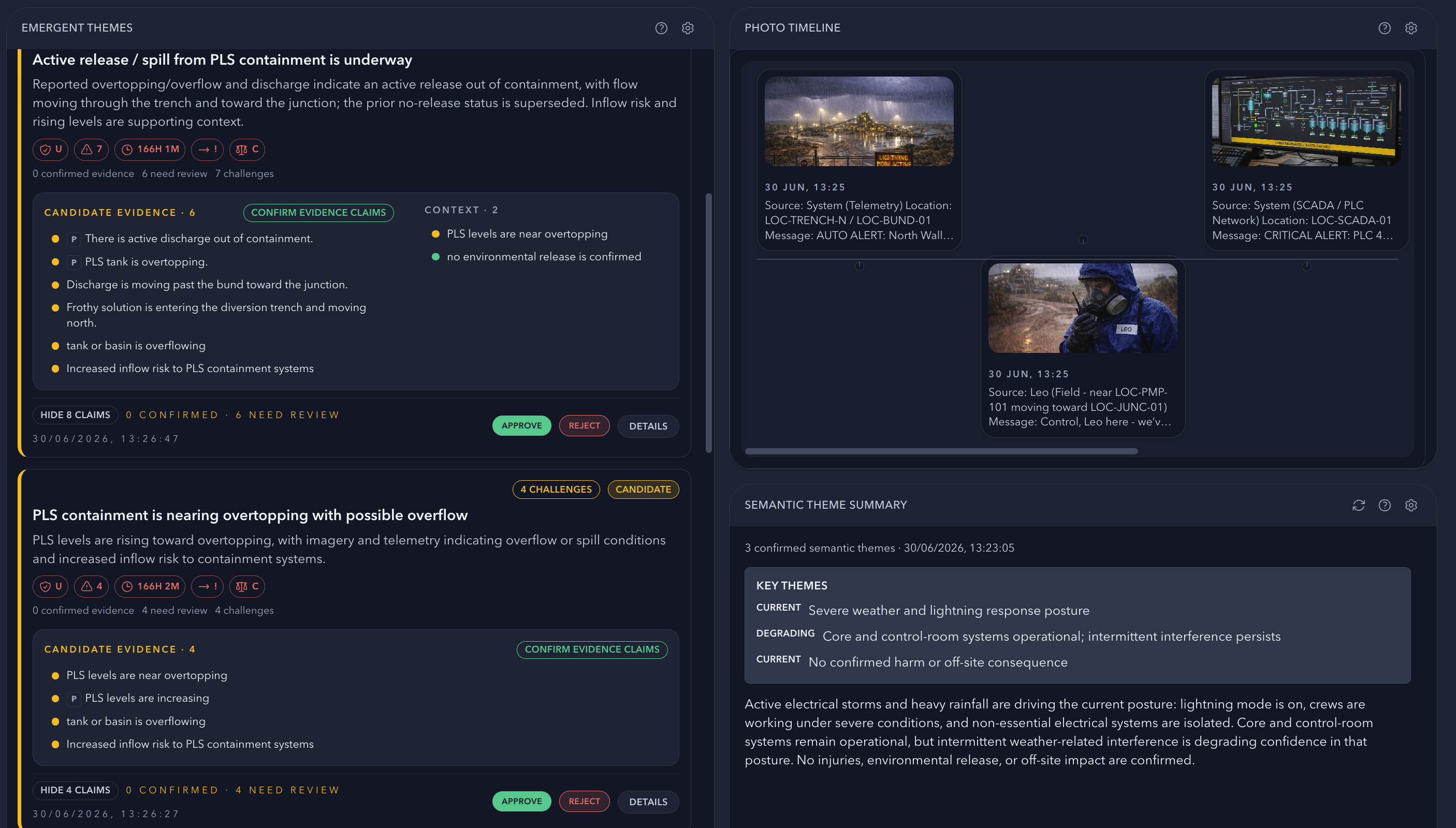
Practice from real records
Revisit what happened, replay the response, or start a new scenario from an existing exercise or incident record.
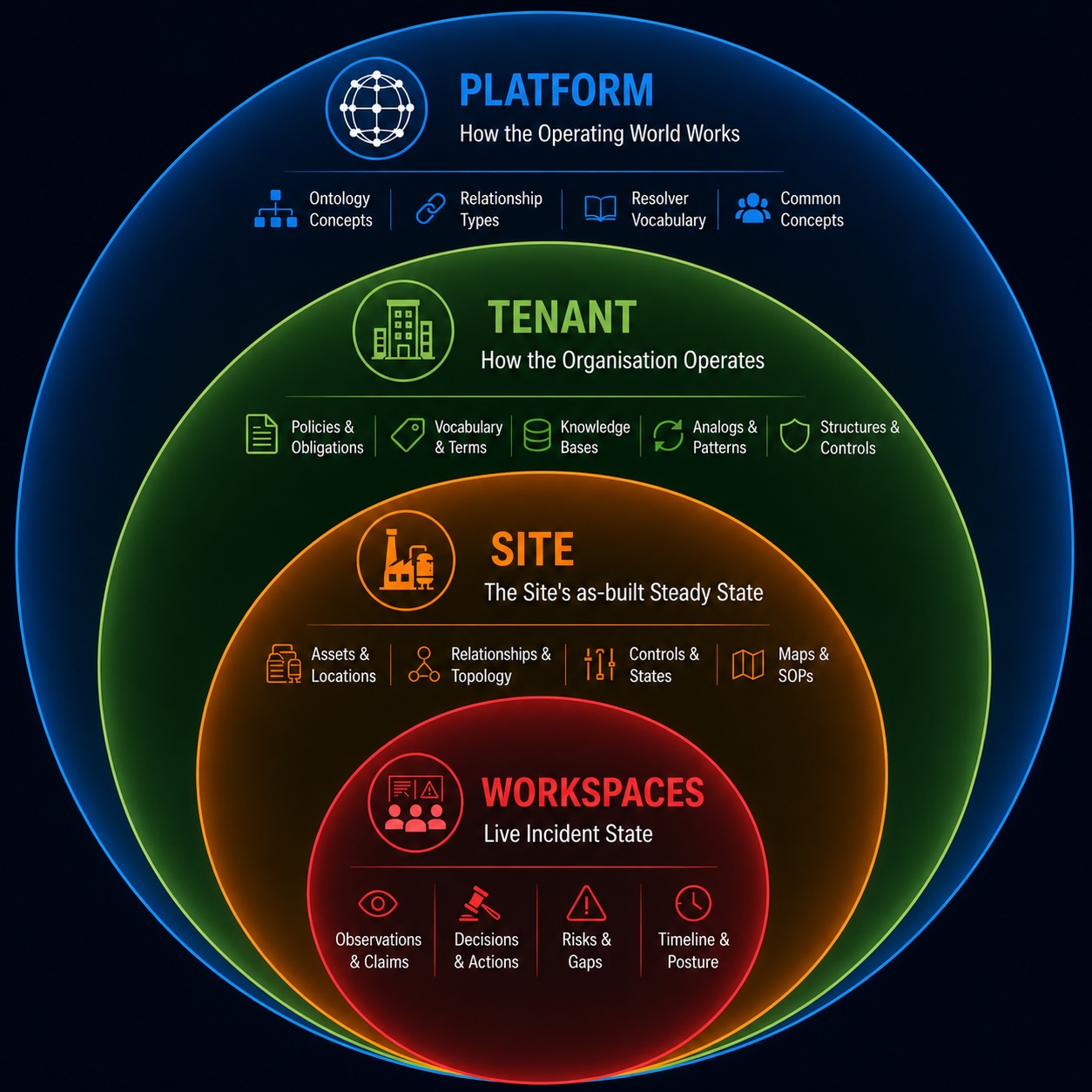
Operational World Model
SafeSite Response uses one world model with four authority rings. The rings define who governs each record, how broadly it applies, and what evidence is needed before it can influence incident reasoning.
Reads flow inward: a live workspace reads the selected site baseline, tenant knowledge, and platform meaning. Writes do not flow outward automatically.
Incident observations become reusable site, tenant, or platform knowledge only through governed review, keeping urgent response work connected to context without polluting the permanent model.
Site layer example
The Site ring is the as-built steady state for a physical or operational site. It grounds concrete entities and relationships: what exists, where it is, how it connects, what state is normal, and where consequences can travel.
During an incident, the workspace can read this baseline to tell the story of what has changed instead of treating every observation as an isolated fact.
How the Operating World Works
Defines the ontology concepts, relationship types, resolver vocabulary, and common concepts that give every workspace a shared operational language.
How the Organisation Operates
Adds organisation-specific policies, obligations, vocabulary, knowledge bases, analogs, patterns, structures, and controls.
The Site's as-built Steady State
Holds the assets, locations, relationships, topology, controls, states, maps, and SOPs that describe how the site normally works.
Live incident state
Captures observations, claims, decisions, actions, risks, gaps, timeline, and posture as live changes from the selected site baseline.
Analog Intelligence
SafeSite Response turns past incidents into fingerprinted scenarios: signals, degraded controls, decisions, delays, constraints, and outcomes mapped as reusable operational patterns. Those analogs can come from a governed library of incidents across industries, or from your own corporate knowledge base.
What makes it powerful
SafeSite Response learns from operational patterns that emerge across incidents, industries, and environments.
Different events can generate the same operational pressures: degraded communications, blocked access, uncertain field visibility, control failures, fragmented information, and time-critical decisions made with incomplete knowledge.
These recurring signals form operational fingerprints. SafeSite continuously compares those fingerprints against governed cross-industry incidents, exercises, and your organisation's own experience to surface relevant patterns, risks, and lessons in real time.
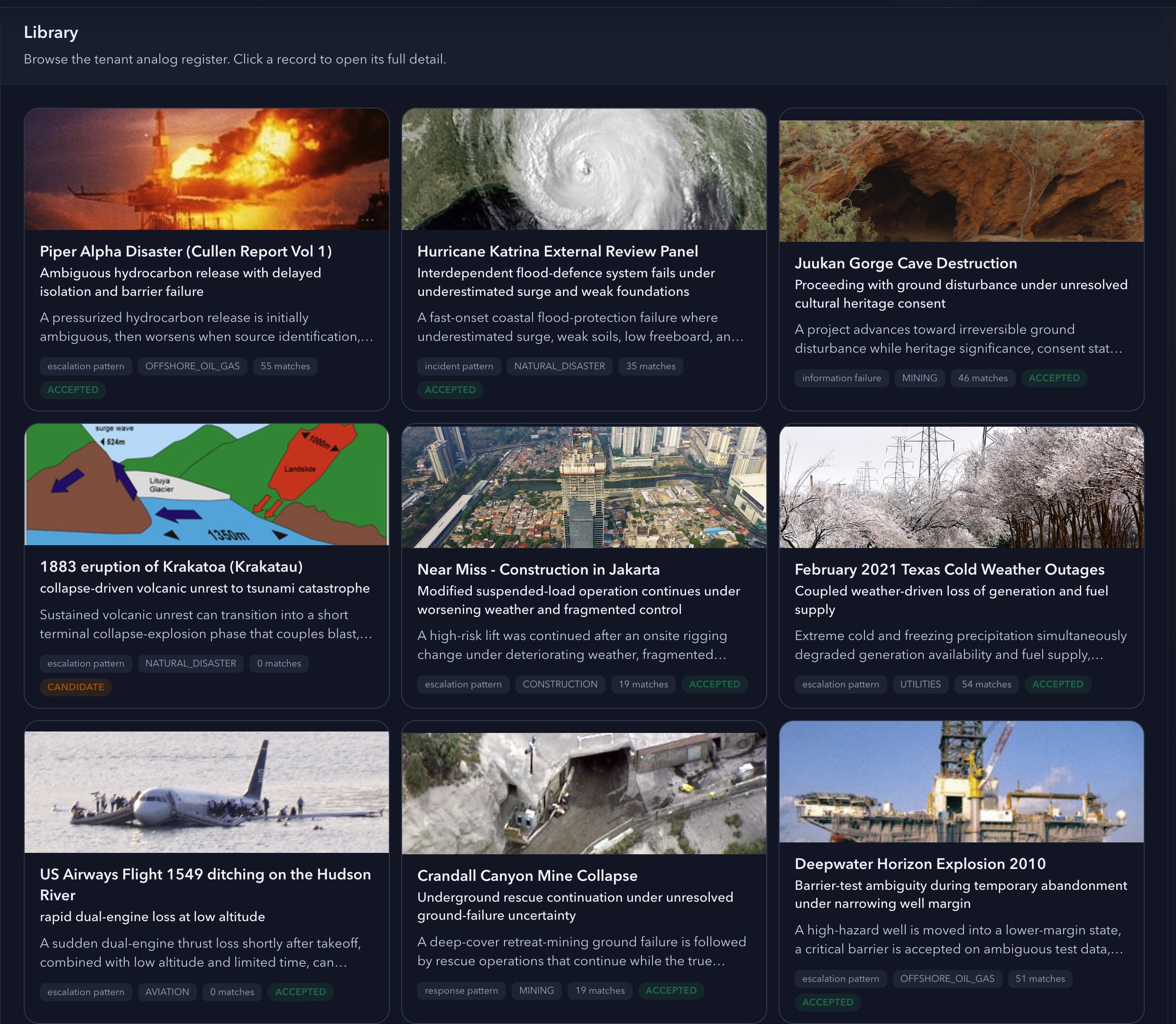
Comms degradation, blocked access, missing field visibility, control failure, time pressure.
Signals are mapped to decisions, constraints, degraded controls, delays, and outcomes.
The live incident is compared against a governed incident library and your corporate knowledge base.
Relevant patterns, risks, and lessons surface while the response is still unfolding.
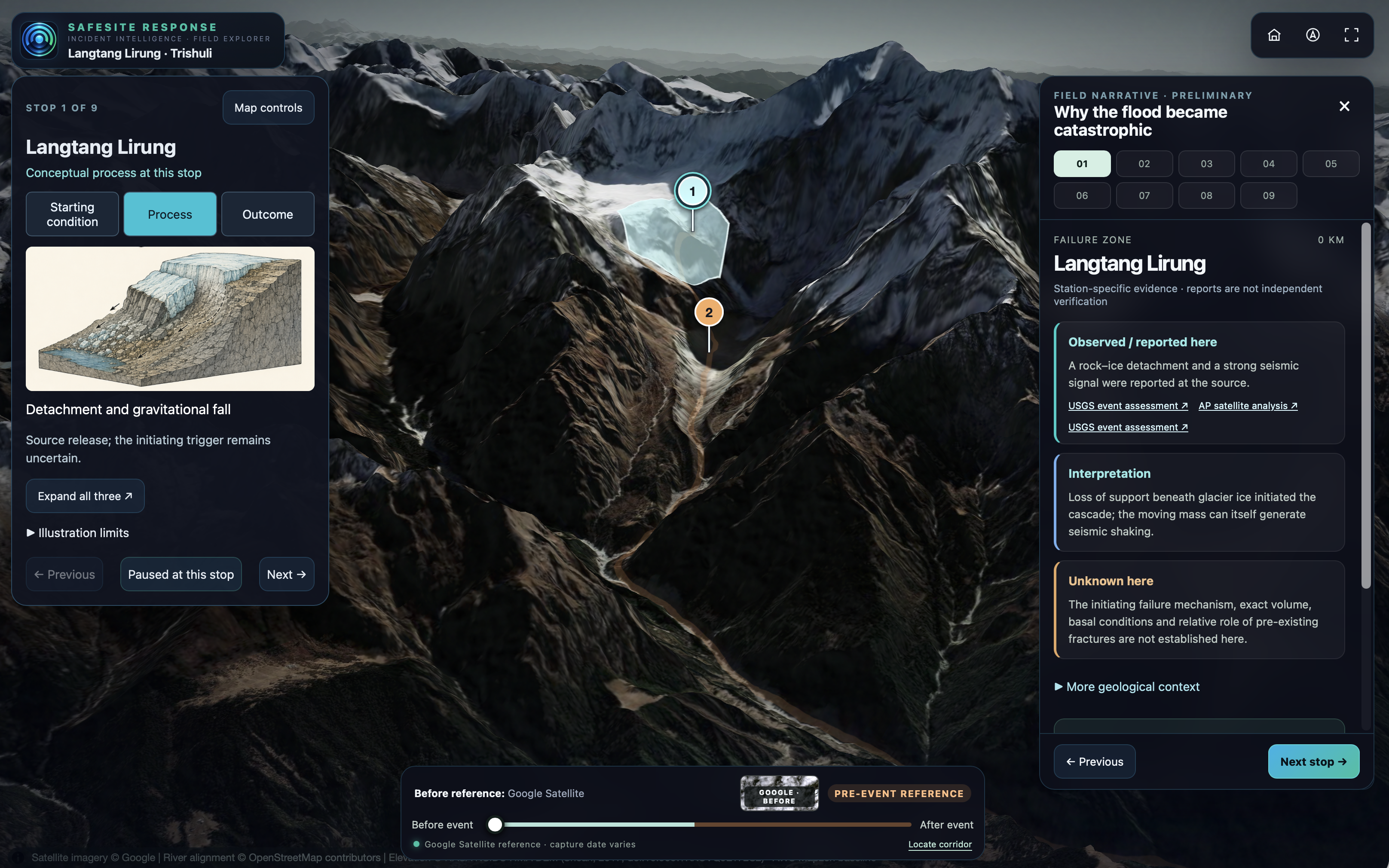
Case Study · Geological Analysis
This case study examines the glacier collapse and catastrophic debris flow and flooding that struck communities across the Nepal–China border region on 26 August 2026.
We recognise that this is not an abstract event. It has caused a devastating loss of life, and many people remain missing. Our hearts go out to everyone who has lost loved ones, those still waiting for news, the survivors, and all affected communities.
Studying tragedies like this with care and respect can help us understand cascading geological hazards, strengthen warning systems, and prepare communities for similar events in the future.
The planning tool groups proposed actions by horizon so command teams can see what matters now, what is forming next, and what needs preparation before it becomes urgent.
Critical planning activities
The first 3 planning moves by horizon, ordered by what matters next.
Containment overtops and runoff spreads
Containment overflow worsens
Containment overflow worsens
Access, crew location, and comms remain degraded
Control and power instability disrupt processing
Site access remains constrained
Prolonged wet weather limits access and recovery
Post-storm stabilisation and repair phase
Post-storm stabilisation and repair phase
One workflow supports live command, post-event accountability, and training from the same governed record.
Incident Command
A live workspace for facts, risks, decisions, and actions while the incident is active.
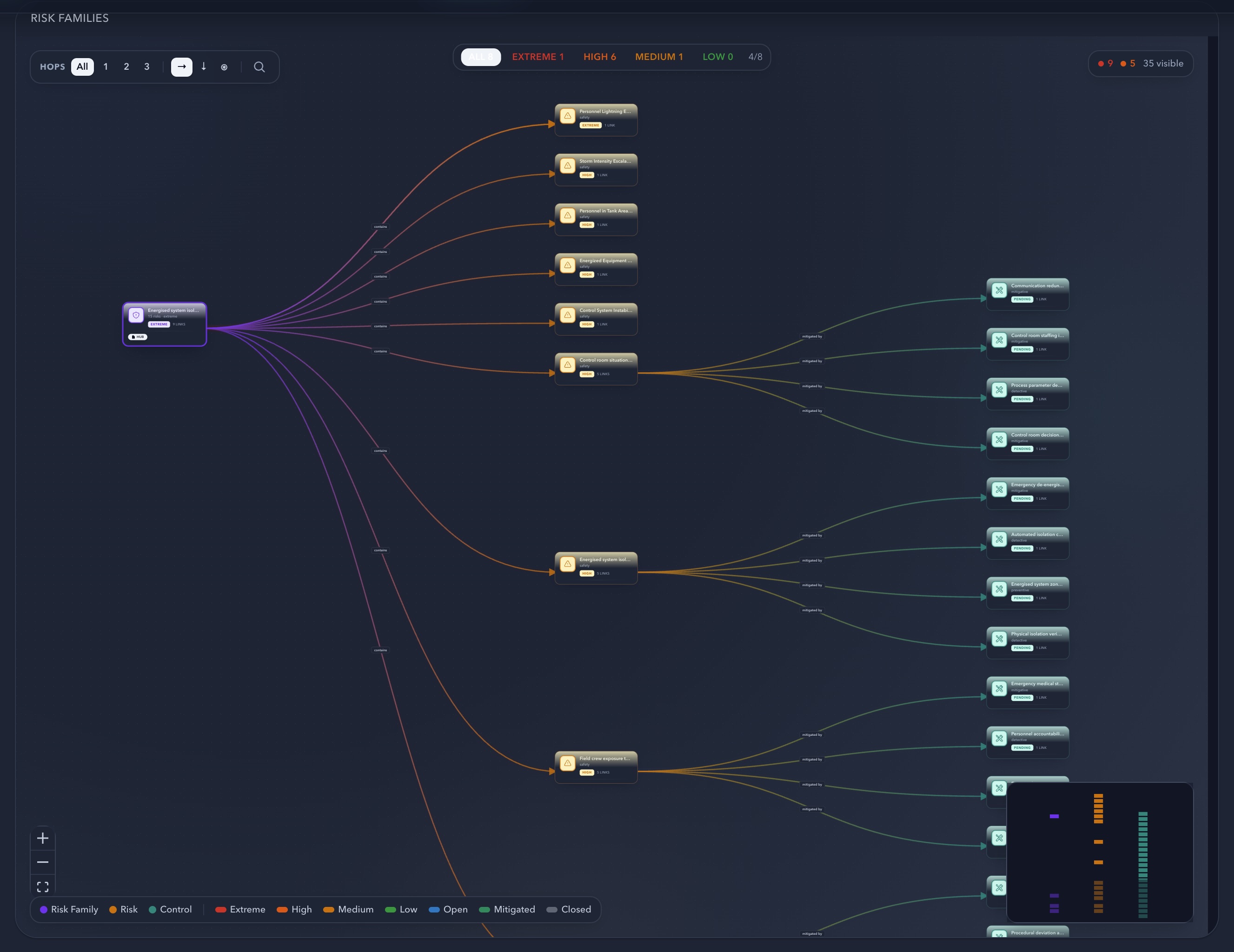
Regulatory Review
Show what was known, who decided, when they decided, and what evidence supported it.
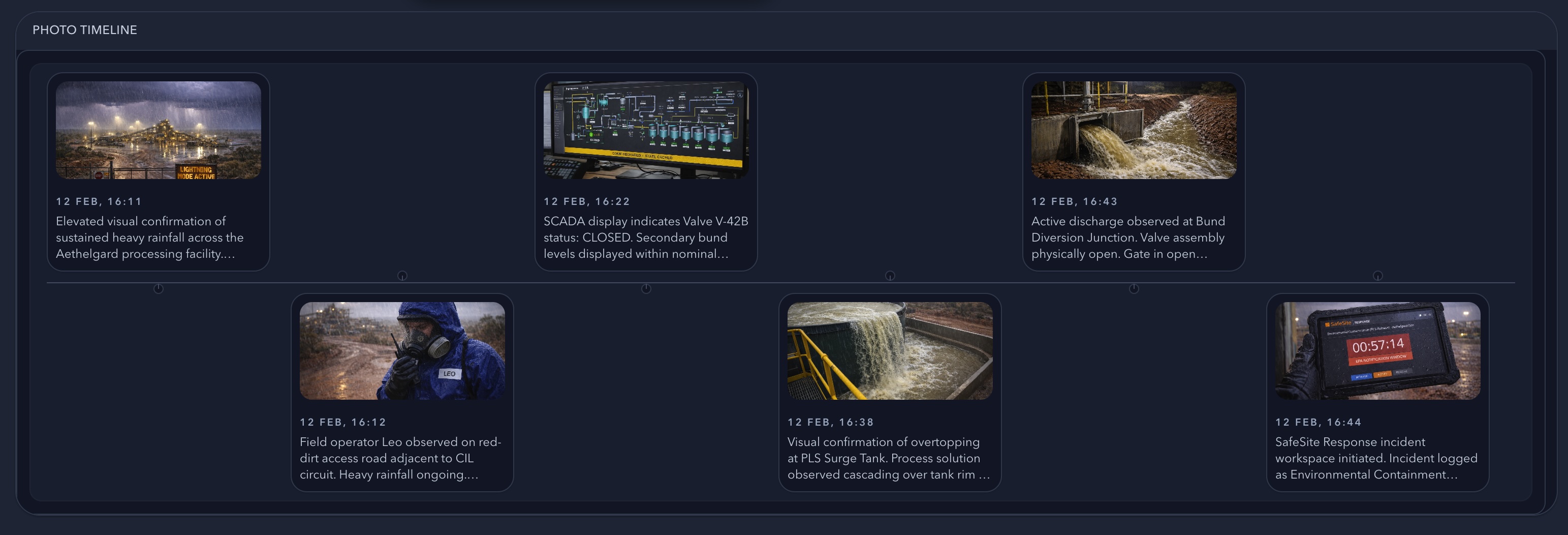
Training & After Action Review
Replay the response as it unfolded, then use it to train teams against real decision points.
AI organises fragmented inputs so teams can focus on judgement.
Named authority removes ambiguity about who decided what.
The workflow keeps attention on the next necessary decision.
Facts, decisions, owners, and outcomes stay attributable.
The Team
SafeSite Response is designed by people who have operated in high-consequence environments and understand what command teams actually need under pressure.

Chief Executive Officer & CTO
Steve brings an international career spanning BP, Rio Tinto, and IMDEX across energy, mining, and advanced technology. He specialises in operational AI, decision-support systems, and governance-first platforms for high-risk industries, with deep expertise in data, geoscience workflows, and building resilient systems that strengthen decision-making under pressure.

Chief Commercial Officer
Mike brings more than 30 years' experience across energy, subsurface data, digital transformation, and technical consulting. He has led commercial growth, regional operations, and strategic data initiatives across Europe, Southeast Asia, Africa, and Australia, supporting organisations including BP, Neptune Energy, Addax Petroleum, Landmark Graphics, Shell, and Chevron.
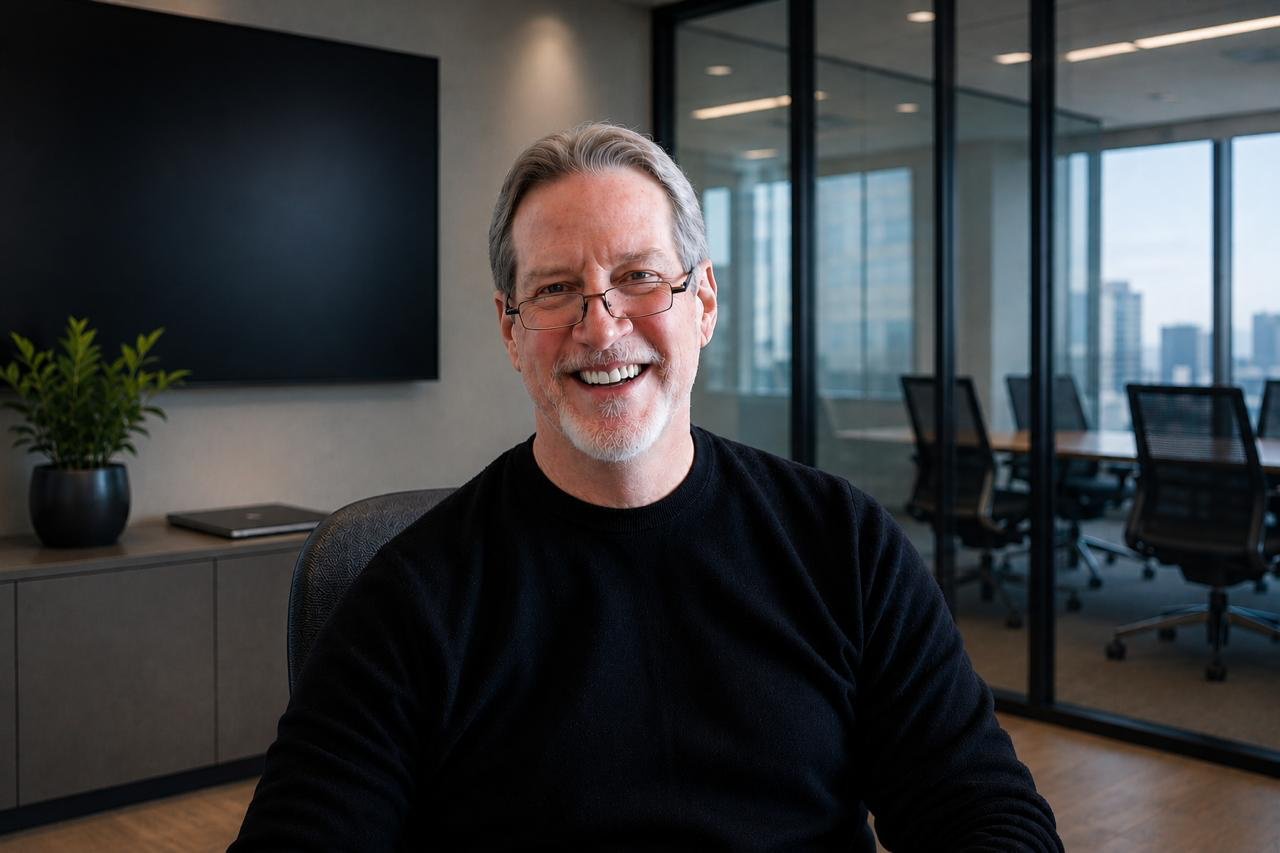
Consulting Director
Don brings deep experience in operational delivery, enterprise systems, and field technology across complex industrial environments. He has led regional operations and service teams across Southeast Asia, the Middle East, Africa, and the Americas, working where technical systems must perform under real operational and regulatory constraints. As Consulting Director, he focuses on turning technical capability into practical operating models that teams can deploy, adopt, and rely on in the field.
Tell us about your response environment and we will arrange a focused demo.